
IRRIGATION

The Australian dried grape industry strives for innovation, ensuring its processes are efficient, sustainable and fair.
What is Evapotranspiration?
Evapotranspiration refers to the combined loss of water from a vegetative surface through both transpiration by plants and evaporation from the soil. Daily evapotranspiration figures are generated by weather stations combining the effects of solar radiation, temperature, wind and humidity to estimate crop water use. Evapotranspiration is measured in millimeters (mm).
Reference Evapotranspiration (ETo)
ETo figures represent an estimate of the water used by a healthy, well-watered, full cover grass surface. It provides a standard method to compare water use across a range of crop types and locations.
Crop coefficients (Kc) for dried vine fruit
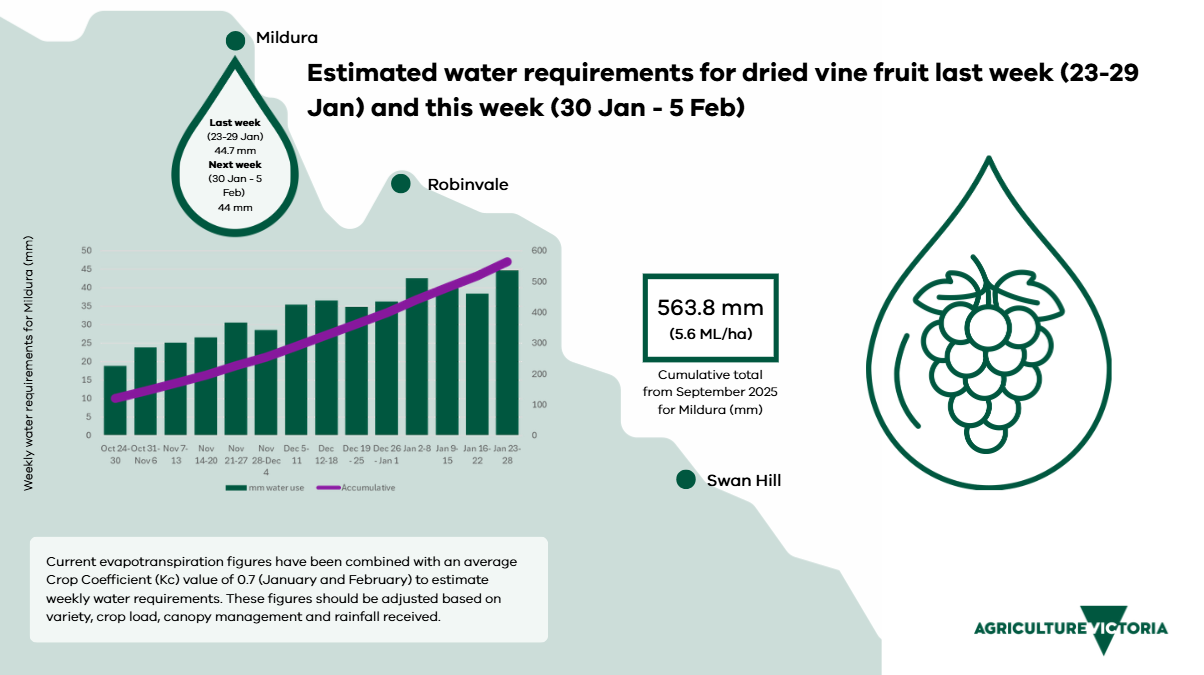
Most horticultural crops do not fully cover the ground, and the ETo figure needs to be adjusted by a crop coefficient (Kc) in order to estimate the crop evapotranspiration (ETc). Crop coefficients are a set of numbers that reflect the crop being grown and the developing canopy. These adjustments have been made in the following graphic to estimate recent and future dried fruit water requirements at Mildura. This knowledge can assist dried vine fruit producers with their irrigation management.
The table below is the set of Kc values used in these calculations. They represent moderate vigour dried vine fruit. Kc values will vary slightly with variety, growth stage, crop load, canopy size, rootstock, soil type and row spacing.
| Month | Crop Coefficient (Kc) |
|---|---|
| August | 0.3 |
| September | 0.4 |
| October | 0.5 |
| November | 0.65 |
| December | 0.7 |
| January | 0.7 |
| February | 0.7 |
| March | 0.7 |
| April | 0.5 |
| May | 0.5 |